%20(1200%20x%20237%20px)%20(300%20x%2059%20px).webp)
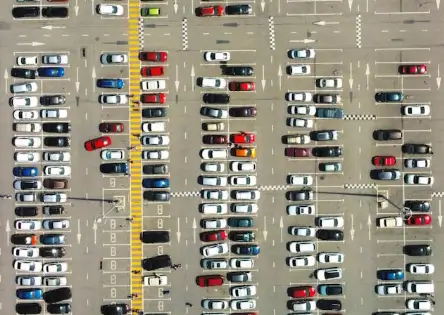
You rarely notice parking minimums.
Is not like they announce themselves or show up with welcome signs.
They don’t even get debated at dinner parties (a sad missed opportunity for family drama).
However, parking minimums quietly shape nearly everything around you.
How far apart buildings sit. Why walking feels awkward. Even why housing costs so much.
Ever wonder why your town looks like a slightly rearranged version of every other town? Parking minimums...among other things but parking minimums is one of the reasons.
What parking minimums really are
Parking minimums are zoning rules that require new buildings to include a set number of off-street parking spaces.
Two spaces per apartment.
Four or five spaces per 1,000 square feet of retail.
One space for every few restaurant seats.
The exact numbers vary by city and are oftern quite arbitraty, but the idea is the same everywhere:
Assume driving is mandatory. Then design everything around that assumption.
Unfortunately, these requirements are rarely based on local data.
Many come from old planning manuals, suburban standards from the 1950s and 60s, or numbers copied from neighboring cities.
But once they’re in the zoning code, they become automatic.
Projects aren’t judged on whether parking is needed.
They’re judged on whether parking is provided.
and that difference is crucial to understand.
Parking minimums decide what gets built
Here’s the part most people miss.
Parking minimums don’t just add parking.
They determine what is even possible to build.
for example, say a small apartment building is being proposed on a narrow lot?
The building fits. The parking doesn’t.
So the project dies.
How about a corner café in a neighborhood?
Great idea. No room for required spaces.
So it never opens.
Or, how about this, a historic building someone wants to reuse?
Can’t meet modern parking rules.
So it sits vacant.
Parking minimums quietly favor projects with lots of land and lots of capital.
Think big chains, large developments, and drive-through businesses. Yes, drivethroughs...one of the developments most neighborhoods don't want near because traffic becomes a major issue.
Small, local, walkable ideas get filtered out before they ever reach the market.
It's a tall lie that masks itself as consumer preference but in reality is more like a regulation shaping outcomes.
Why cities spread out
Parking takes up enormous amounts of space.
A single surface parking space, including aisles and circulation, uses roughly 300 square feet.
That’s about the size of a small bedroom.
Now multiply that by dozens or hundreds of spaces.
That land has to come from somewhere.
So buildings get pushed farther apart.
Lots get bigger.
Blocks get longer.
Distances increase.
There’s an old saying: when you say “yes” to something, you’re automatically saying “no” to something else. Parking minimums say “yes” to low-value, inefficient land use, and “no” to financially responsible, productive development. If parking minimums were a private business, they’d collapse in less than a month. The return on investment would be indefensible and completely unsustainable.
Lower density isn’t a cultural choice.
It’s often a mathematical consequence of parking rules.
When everything is spread out, walking becomes inconvenient.
Transit becomes inefficient and sadly driving becomes the default.
Then we point to all the cars and say,
“See? People here need parking.”
The rules created the behavior, then justified themselves.
The hidden cost of “free” parking
Parking isn’t free.
It’s just hidden.
Surface parking consumes valuable land that could be housing, shops, or public space.
Structured parking can cost tens of thousands of dollars per space to build and these costs just don't simply disappear.
They morph into rent prices, home prices, commercial leases, and higher prices for goods and services.
You’re paying for parking in your grocery bill.
In your coffee.
In your monthly rent.
Parking minimums force everyone to subsidize driving, whether they benefit from it or not. Guess what, if you don't drive, you still pay for those who do? How is that fair?
How parking reshapes streets
Look at a typical commercial corridor.
They're usually characterized by wide lanes, multiple driveways, few trees, and buildings buildings set far back behind asphalt.
It's a grotesque lack of ingenuity when it comes to parking geometry.
More required parking means more curb cuts.
More curb cuts mean more conflict points between cars and pedestrians.
Streets get wider to accommodate turning movements.
Speed increases.
Noise increases.
Safety decreases.
Sidewalks shrink.
Tree space disappears.
Street life fades.
And then we wonder why streets feel hostile and empty, why pedestrian fatalities are so high, why there are less people walking. The answer is staring at us...every time we drive by a half used, landscape of concrete.
The irony of good intentions
To be fair, parking minimums weren’t created out of malice.
They were meant to solve problems like on-street congestion, neighborhood complaints, and spillover parking.
Unfortunately over time, they created new ones such as car dependence, sprawl, higher housing costs, financially risky development, and dead public spaces.
They addressed yesterday’s fears by locking in today’s dysfunction.
What happens when cities remove parking minimums
When cities eliminate parking minimums, something surprising happens.
Not chaos.
Not parking anarchy.
Choice.
I saw this when I worked for the City of Gainesville, FL where I worked to propose the removal of parking minimums. It passed, and with it we saw developers that still build parking because the market demands it, but then others build less parking, while some build none. It didn't destroy parking in the city or created some apocalyptic traffic scenario. However we did see small projects become viable again. Older buildings become easier to reuse, and design becoming more flexible.
Parking doesn’t disappear.
It just stops controlling everything else.
This isn’t anti-car
Parking reform isn’t about banning cars, and most definitely isn't about punishing drivers.
It’s about removing a mandate.
It’s about letting neighborhoods decide how much parking actually makes sense, instead of enforcing one-size-fits-all numbers everywhere.
Cars still exist.
Parking still exists.
It just stops being the primary design driver.
Why this matters to you
If you’ve ever wondered: why housing feels unaffordable, why walking feels uncomfortable, why local businesses struggle, or even why your city feels fragmented...I'll give you a clue...the parking code.
Parking minimums are one of the most powerful, least discussed forces shaping American cities.
Once you see them, you start noticing the pattern everywhere.
And once you understand them, you realize something important:
Cities didn’t become this way by accident.
They were designed this way.