%20(1200%20x%20237%20px)%20(300%20x%2059%20px).webp)

You’ve probably parked your car a thousand times without thinking about the space it takes up. You slide into a stall, grab your keys, and walk away. No big deal. But when you stand inside a small bedroom and realize the same car-sized rectangle on the ground is bigger than the room you sleep in…you start to see the problem a little differently.
Most parking spots in the U.S. run about 9 feet by 18 feet. That’s 162 square feet.
A huge share of “affordable” bedrooms being built right now? Often 10 by 10. That’s 100 square feet.
Your car gets more square footage than you do.
And that didn’t happen by accident.
Cities wrote it into law.
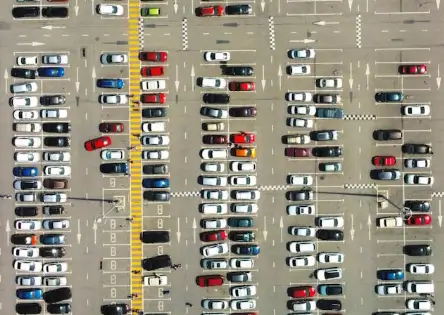
Minimum parking rules, on the books since the mid-20th century, told builders exactly how many stalls they must provide for housing, stores, offices, restaurants, gyms, churches, you name it. Over time, those requirements ballooned to the point where the parking footprint of a building often dwarfs the building itself. In many cities, there is more land dedicated to storing cars than to housing people.
Think about that for a second.
We’ve let parking lots grow so large that they’re now one of the biggest land uses in our communities. And we barely question it.
My first “what the heck?” moment came years ago when I purchased my first home. My spare bedrooms where 10 x 13 (130 sq. ft.) and 12 x 13 (156 sq. ft.) . The rooms felt comfortable, I used one as an office. Then one day, I happened to be working on a development review for a new commercial building where I had to make sure the size of the provided parking spaces where consistent and met regulations. And for whatever reason, it hit me. The provided parking spots where larger than my bedrooms...all 120 parking spots. And that was not even courting the loading areas! The math clicked immediately. We’re trading livable space for asphalt. We’re shaping people’s daily lives around a vehicle that sits unused around 95% of the time.
And when you zoom out, the implications get heavier.
Parking eats up land that could hold more housing, parks, shops, or community spaces. Every oversized lot spreads things farther apart, which forces more driving. More driving means more congestion, more emissions, and more money poured into road expansions that never solve traffic. The cycle continues until everything is pushed out, farther and farther, leaving you with neighborhoods where walking becomes almost impossible.
Developers feel the squeeze too.
Every required stall costs money...and lots of it. Typically $5,000 to $40,000 per space depending on whether it’s surface, structured, or underground. In some projects, parking eats up 20–30% of the total budget. That’s money that could have gone to better materials, larger units, or lower rents.
It gets even stranger:
Research shows that parking often sits half-empty. Donald Shoup, one of the leading experts on parking, has shown that minimum parking requirements act as a hidden subsidy. Cities force developers to build far more parking than demand justifies, and the cost gets baked into rent, groceries, and everyday prices.
Parking mandates work the same way minimum lot sizes do, they bloat everything. They make your city more expensive to build in, harder to navigate without a car, and nearly impossible to grow in a compact, efficient way. A single oversized parking lot might not seem like a big deal, but multiply that by every grocery store, doctor’s office, and shopping plaza in your corridor, and suddenly you’re living in a place where daily life feels inconvenient and spread thin.
Ask yourself this:
How many places do you go where the parking lot is larger than the building itself?
How many plazas were clearly designed for the movement of cars, not people?
How often do you find yourself walking across an empty lot that feels like a desert of asphalt?
It’s not just bad design. It shapes behavior.
Kids can’t walk to school easily.
Older adults lose independence when driving becomes their only option. Families spend thousands each year owning multiple cars because the built environment leaves them no choice.
U.S. cities may have as many as eight parking spaces for every car. That’s millions of acres locked into storage, not homes, parks, or places to live life. Meanwhile, many new apartments are getting smaller, as developers squeeze units to offset rising land and construction costs.
Bigger parking spots. Smaller homes.
It flips the logic of city-building on its head.
Some cities have started to push back. Minneapolis, Portland, Buffalo, Raleigh, Gainesville, and dozens more have eliminated parking minimums altogether. Builders can still provide parking if they want, but they’re not forced to pave half the lot to meet a one-size-fits-all formula. Early results are already showing:
- More housing units on the same land
- Lower construction costs
- More walkable, mixed-use projects
- Fewer empty parking lots baking in the sun
When cities remove parking mandates, they’re not banning parking. They’re letting the market build what actually makes sense. They’re freeing land for better uses. And they’re giving people the chance to live in places where daily life doesn’t revolve around a metal box.
Next time you pull into a stall, pause for a second. Stand in it if you can.
Look at the painted lines.
Feel the space your car receives by default.
Now picture what a 162-square-foot bedroom would feel like.
Picture what 162 square feet of community space could be. A garden bed, a playground corner, a pocket park, a coffee shop patio, a little sliver of life.
When the parking spot is bigger than your bedroom, the problem isn’t your bedroom.
It’s the system that decided your car deserves more room to rest than you do.